Small Molecule Highlights #22 – March 2024

Small Molecule Highlights #22 – March 2024

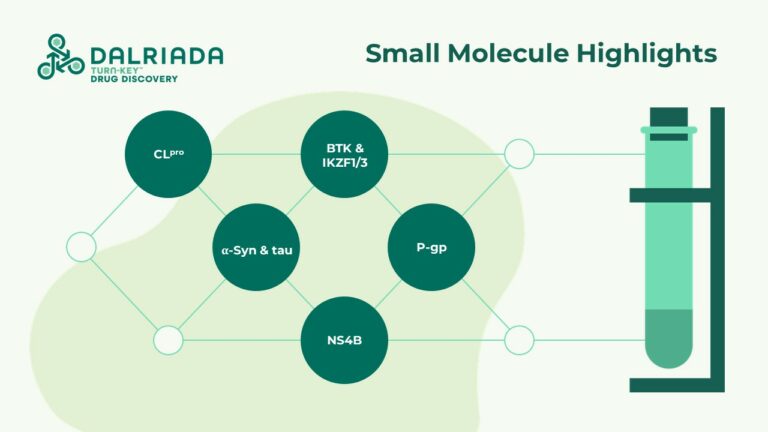
In this issue of “Small Molecule Highlights” we bring you 5 new small molecules out of recent drug discovery journals. These molecules target a diverse selection of targets, including SARS-CoV-2 3C-like protease, BTK, IKZF1/3, tau, α-synuclein  and NS4B. Enjoy!

MK-7845
MK-7845
MK-7845

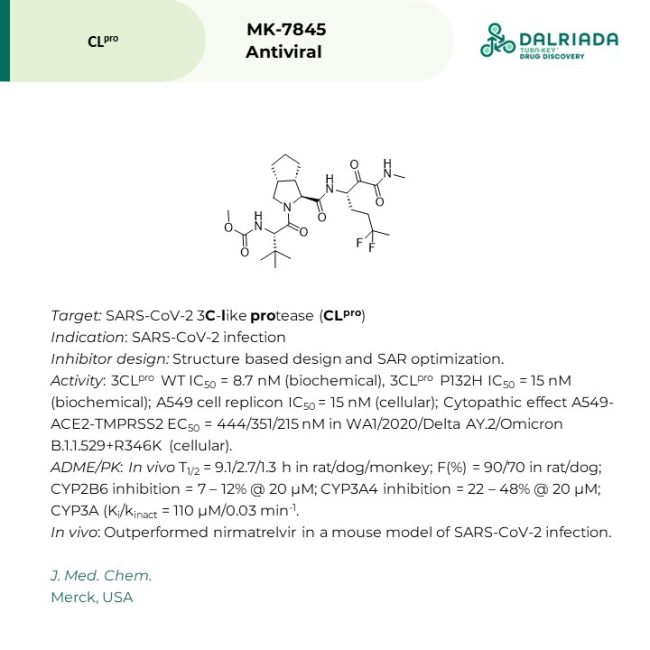
MK-7845:  This SARS-CoV-2 3C-like protease (CLpro) inhibitor developed by Merck took aim at improving the poor pharmacokinetic and toxicity profiles plaguing previous modulators of this target.  To address the PK issues, the medicinal chemistry team identified a hepatitis C virus (HCV) protease inhibitor (boceprevir) with weak CLpro activity and greatly improved oral bioavailability as a starting point.  To enhance activity, SAR around the glutamine mimic was crucial.   This structural motif is common to all  CLpro inhibitors and confers selectivity towards the viral protease.  Past mimics have utilized a pendant pyrrolidinone substituent to make the necessary H-bond interactions with His164, however, this group adversely affects the solubility and metabolic profile of previous congeners.  Employing structural based drug design, the scientists were able to winnow out replacement options to arrive at a unique gem-difluorinated glutamine mimetic with the desired properties.  Interestingly, only one of the fluorines was shown to participate in the H-bonding interaction with His164 and fluorine deletion compounds designed to probe this observation were able to substantiate it empirically.  Further modification of the parent scaffold, including optimization of the core bicyclic proline and ketoamide warhead, were used to  dial in the requisite potency and pharmacokinetic properties.  In vitro, MK-7845 was shown to be a potent inhibitor  in FRET based CLpro activity assays (IC50 = 8.7 nM) and A549 cellular replicon systems (IC50 = 15 nM).  Also, the compound demonstrated similar activity in cellular models of SARS-CoV-2 parental, delta, and omicron infection (EC50 = 444, 351, and 215 nM, respectively).  Pharmacokinetic characterization revealed good oral bioavailability in rat and dog (F(%) = 90 and 70, respectively), and a projected human oral bioavailability of 67%.  MK-7845 was found to induce CYPs 2B6 and 3A4 at 20 μM. In the case of CYP3A, time-dependant inhibition was observed (Ki/kinact = 110 μM/0.03 min-1), a potential concern for drug-drug interactions at elevated concentrations. Preclinical evaluation in a mouse model of SARS-CoV-2 infection indicated superior control of viral load compared to nirmatrelvir (Pfizer).  There was no mention of follow-up clinical studies.  In scope, the development of MK-7845 has supplied medicinal chemists with a novel and non-obvious glutamine mimetic (gem-difluorobutyl group).  It will be interesting to see how this substituent is deployed in future drug discovery/development efforts.     

Reference: https://doi.org/10.1021/acs.jmedchem.3c02248

NX-2127
NX-2127
NX-2127

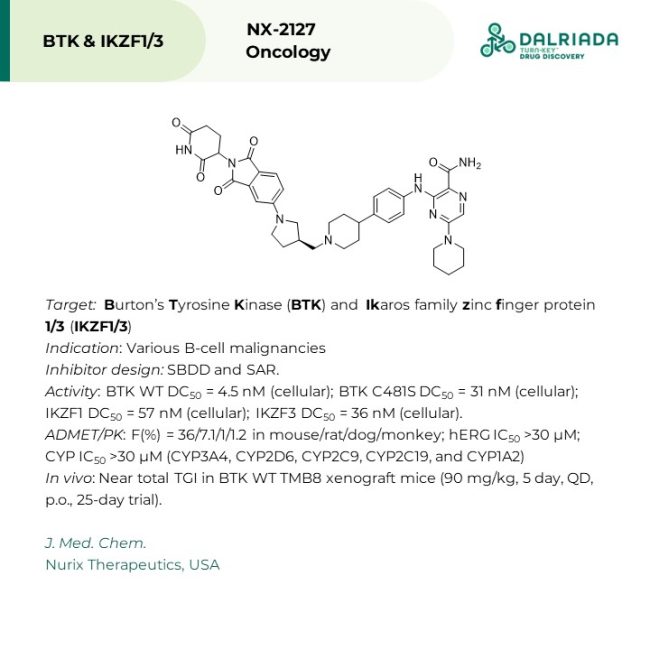
NX-2127: Scientists at Nurix Therapeutics have developed a dual acting PROTAC/molecular glue targeting both BTK and IKZF1/3.  Spurred by results supporting the combination of ibrutinib (BTK covalent inhibitor) and lenalidomide (often used E3 recruiting ligand for PROTACs) for the treatment of diffuse large B cell lymphoma (DLBCL), the combination of the two as a dual targeting agent was too irresistible to pass on.  Towards this end, medicinal chemists used structural and in silico design-based approaches to identify a tractable BTK targeting scaffold with the correct exit vector to accommodate an E3 recruiting ligand.  Iterative rounds of SAR guided by activity against BTK and IKZF3 eventually led to compound NX-2127.  During the structural evolution of NX-2127, one of the key alterations made was deletion of a cyclic urea substituent from the parent scaffold, which helped to increase in vivo potency and limit partitioning in plasma.   Characterization of the compound in cells revealed potent BTK degradation in WT and  C481S (covalent resistance mutation) harboring TMD8 cells (DC50 = 4.5 nM and 31 nM, respectively), as well as IKZF1 and IKZF3 in primary T cells (DC50 = 57 nM and 36 nM, respectively).  Good oral bioavailability in mouse (F(%) = 36) and in vivo BTK degradation was observed across species (%BTK remaining after 24 h = 21/17/10 in mouse/dog/monkey).  Pharmacodynamic studies were carried out in xenograft mice containing either BTK WT or C481S transformed TMD8 tumors.  Dose-dependant control of tumor volume was observed with NX-2127 with nearly 100% tumor growth inhibition (TGI) occurring at the highest dose tested (90 mg/kg, 5-day, QD, p.o., 25-day trial).  Importantly, the compound was able to limit growth in BTK C481S harboring xenografts where no effect was observed with ibrutinib.  Follow-up toxicology tests to enable clinical profiling did not identify an issues (AMES was negative; hERG IC50 > 30 μM; no CYP inhibition of major isoforms).  Given the agreeable PK and clean toxicology profile, NX-2127 is currently being evaluated patients with B-cell cancers (NCT04830137).  As a brief preview of the clinical data, the authors reported sustained degradation of BTK (80%) in CLL patients (100 mg daily, QD, p.o.) enrolled in the trial.     

Reference: https://doi.org/10.1021/acs.jmedchem.3c01007

Compound T3
Compound T3
Compound T3

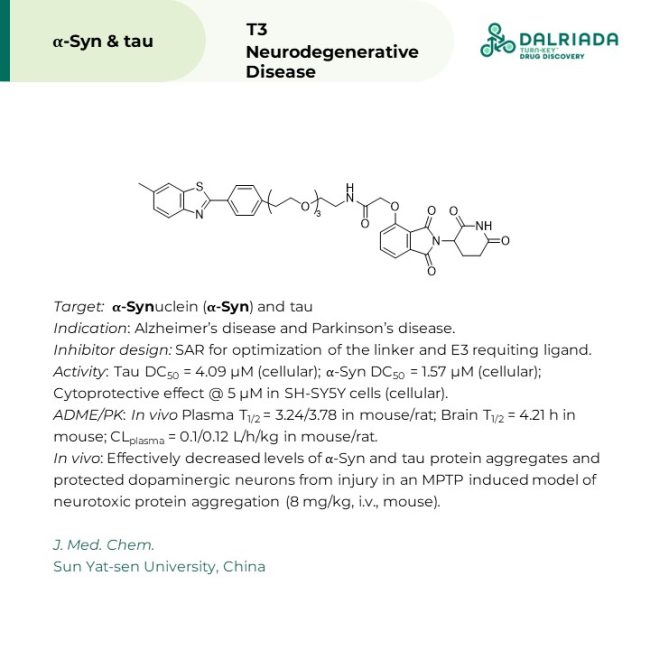
Compound T3:  Staying on the topic of dual-targeting degraders, researchers at Sun Yat-sen University recently disclosed their efforts to develop a PROTAC targeting two prominent neurodegenerative  disease proteins (NDPs), tau and α-synuclein (α-Syn).  As a therapeutic modality, targeting both proteins will likely confer greater benefit as there is a growing body of evidence supporting crosstalk between NDPs.  The challenge, finding a ligand/linker/E3 recruiter combination that can effectively degrade both targets selectively whilst maintaining good CNS penetration.  For the ligand, choices were relatively meager.  The medicinal chemists decided to go with BTA (2-[49-(Methylamino)phenyl]-6-methylbenzothiazole), an analogue of the fluorescent amyloid contrast reagent Thioflavin-T.  BTA has previously been shown to bind protein aggregates/oligomers and have good BBB penetration.  A relatively limited SAR was conducted around the linker and E3 recruiting substituent, ultimately landing on a PEG4-linked thalidomide as the optimal combination.  T3 dose-dependant degraded tau (DC50 = 4.09 μM) and α-Syn (DC50 = 1.57 μM) in manipulated HEK293T cells.  Furthermore, degradation of α-Syn was confirmed by proteomics, and immunofluorescence staining coupled with confocal LSM confirmed dose-dependant degradation of tau.  T3 was also shown to play a cytoprotective role in a cellular model of protein aggregate induced cell toxicity (SH-SY5Y neuroblastoma cells).   Pharmacokinetic characterization revealed low clearance in mouse and rat (CLplasma = 0.1 and 0.12 L/h/kg, respectively), and uptake in the brain.  In vivo therapeutic effect was demonstrated in an MPTP induced mouse model of neurotoxic protein aggregation.  Specifically, T3 effectively lowered the levels of α-Syn and tau protein aggregates and protected dopaminergic neurons from injury(8 mg/kg, i.v.).  A preliminary dose escalation/MTD study in mice to assess in vivo toxicity did not reveal any significant side effect.  Taken as a whole, the development of T3 opens a new space for PROTACs in the NDP space, especially in pathologies where more than one target is implicated. 

Reference: https://doi.org/10.1021/acs.jmedchem.3c01719

Compound H27
Compound H27
Compound H27

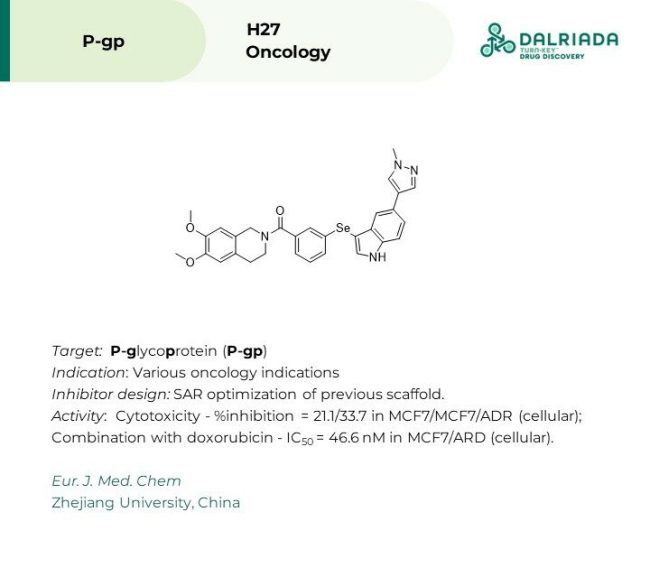
Compound H27: The evolution of multidrug resistance (MDR) in oncology remains a critical challenge in the development of effective chemotherapeutic agents and treatment strategies.  While the exact mechanistic underpinnings are still elusive, the overexpression of ABC efflux transporters, particularly P-glycoprotein (P-gp), appears to be one of root causes of MDR.  Researchers at the Zhejiang University of Technology have taken an interesting approach to develop novel and non-toxic P-gp inhibitors by incorporating selenium.  Commencing from a molecule previously discovered by their group (5m), the medicinal chemists employed a scaffold hopping strategy to replace  a problematic furan with a phenyl selenide substituent conferring greater flexibility and lipophilicity.  SAR around the groups extending from the phenyl selenide identified a 5-substituted indole as the optimal substituent.  Molecular docking studies revealed key interactions between the indole and Phe343 and an H-bond interaction involving the C5-pyrazole and Gln725 of P-gp.  In cells, H27 exhibited limited toxicity in WT and MDR MCF7 cells (21.1 and 33.7% inhibition @ 5 μM, respectively).  However, in combination with doxorubicin, H27 demonstrated sub-micromolar cytotoxic activity (IC50 = 46.6 nM).  Follow up studies in MCF7/ADR cells revealed direct inhibition of P-gp efflux function without modulation of P-gp expression.  While H27 does not appear to be a fully optimized compound, it does offer an example of what can be achieved by looking beyond the third row of the periodic table.  

Reference: https://doi.org/10.1016/j.ejmech.2024.116207

JNJ-1802
JNJ-1802
JNJ-1802

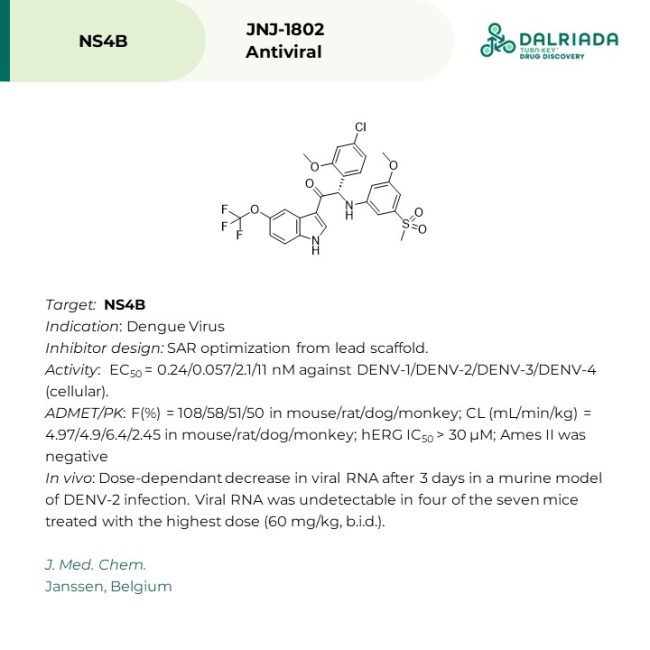
JNJ-1802:  Scientists at Janssen recently published details on their lead optimization of a pan-serotype small molecule antiviral for dengue virus.  As an aside, dengue related illnesses are some of the fastest growing mosquito-transmitted viral diseases worldwide.   Commencing from their previous leads (24a and 28a in https://doi.org/10.1021/acs.jmedchem.3c00403), the team looked to enhance activity across all dengue virus serotypes and the overall pharmacokinetic profile of the scaffold.  One of the most interesting alterations was the replacement of a glycol solubilizing group with a methylsulfone substituent.  The goal here was to curb glycol associated metabolism and maintain potency.  With the sulfone in place, the ortho-methoxyphenyl substituent was essential to maintain the stereochemical configuration of the sole chiral center.  Finally, various functional groups and substitution patterns were sampled on the indole group in an effort to further increase potency.  A trifluoromethoxy substituent at the C5 position of the indole was found to offer the best balance of target inhibition and metabolic stability.  In cellular models of dengue infection, JNJ-1802 exhibited potent activity against all serotypes (EC50 = 0.24/0.057/2.1/11 nM against DENV-1/DENV-2/DENV-3/DENV-4, respectively).  Pharmacokinetic characterization revealed good to great oral bioavailability across species (F(%) = 108/58/51/50 in mouse/rat/dog/monkey) coupled with low clearance (CL (mL/min/kg) = 4.97/4.9/6.4/2.45 in mouse/rat/dog/monkey).  Clinical enabling safety screens/assays did not flag any cardiotoxicity, genotoxicity, or drug-drug interaction concerns.  Pharmacodynamic studies in  AG129 mice inoculated with DENV-2 revealed dose-dependant decrease in viral RNA after 3 days.  Importantly, viral RNA was undetectable in four of the seven mice treated with the highest dose (60 mg/kg, b.i.d.).  Given its potent activity across all serotypes, tractable PK, efficacy in a relevant PD model, and clean toxicity profile, it’s not surprising that JNJ-1802 is progressing to clinical trials.

Reference: https://doi.org/10.1021/acs.jmedchem.3c02336
Share this article:

Similar Articles

Alessandro Monge, PhD

Strategic Business Development Advisor

Dr. Alessandro Monge is a business strategist with over 20 years of experience at the intersection of computational science, artificial intelligence, and drug discovery. He serves as Strategic Business Development Advisor to Dalriada Drug Discovery, where he contributes to the company’s growth by supporting strategic partnerships, refining market positioning, and aligning platform innovation with emerging trends in therapeutics. In parallel, he is Managing Partner at Blue Dolphin, a consultancy focused on corporate and business development in AI-driven drug discovery, where he advises leadership teams on strategic execution, fundraising, and commercial expansion.


With a foundation in quantum mechanics, statistical mechanics, molecular dynamics, and protein modeling, Alessandro brings scientific depth to business leadership. In addition to Dalriada, he serves as Strategic Business Advisor to innovative companies including Pharmacelera and Nanome. He previously held senior management positions at Schrodinger, Iktos and TandemAI.


Alessandro earned his PhD in theoretical physics from The Rockefeller University and conducted postdoctoral research at Columbia University, where he developed algorithms for protein structure prediction. A trusted advisor and thought partner in the biotech and AI-driven discovery space, Alessandro is committed to advancing transformative science through impactful business execution.

Kanchan Devkota, PhD

Associate Director, Biochem, Biophysics & MS

Kanchan Devkota is a versatile biochemist and biophysicist with over 10 years of experience in protein sciences, assay development, and small molecule drug discovery. As Associate Director of Biochemistry, Biophysics & Protein Mass Spectrometry at Dalriada Drug Discovery, he leads integrated teams driving biochemical and biophysical assay development, hit validation, and mass spectrometry-based analytics to support a wide range of therapeutic programs.

Dr. Devkota’s core expertise includes high-throughput screening, enzymology, and quantitative biophysics—spanning technologies such as SPR, ITC, DSF, DSLS, MST and intact mass spectrometry. A certified Radiation Safety Officer at Dalriada, he also brings specialized capabilities in radioligand binding and functional assays. His work has accelerated programs targeting epigenetic modulators, oxidoreductases, and protein-protein interactions across oncology, infectious diseases, and beyond.

He earned his PhD in Biomedicine from the University of Copenhagen (Novo Nordisk Foundation Center for Protein Research), where he focused on protein structure and function. He subsequently held postdoctoral fellowships at the University of Copenhagen and the Structural Genomics Consortium (University of Toronto), contributing to probe discovery for SARS-CoV-2 and cancer targets in collaboration with global pharmaceutical companies including Pfizer, Takeda, BI and Merck.

Since joining Dalriada, Dr. Devkota has played an instrumental role in shaping the company’s scientific direction and partner-driven innovation. His leadership spans not only scientific execution but also business development, client engagement, and project strategy.

An advocate for translational science and collaborative research, Dr. Devkota has published > 10 publications in high-impact journals and remains actively involved in the scientific community through presentations and cross-functional partnerships. His multidisciplinary background and solution-oriented mindset continue to help advance drug discovery initiatives from concept to hit candidates.

Kashif Aziz Khan, PhD

Associate Director, Cell Biology

Kashif Aziz Khan is a seasoned cell and molecular biologist with over 20 years of experience in research and drug discovery. As Associate Director of Cell Biology at Dalriada Drug Discovery, he leads a dynamic, high-performing team at the forefront of developing innovative cell-based assays and advancing small molecule therapeutics targeting oncology, inflammation, GPCRs, and more.

Dr. Khan’s expertise lies in designing, optimizing, and validating high-throughput and mechanistically relevant assays to accelerate lead identification, target engagement, and protein degradation workflows. His strategic leadership and scientific rigor have significantly contributed to the progress of preclinical drug discovery pipelines.

He earned his PhD in Cell and Molecular Biology from the University of Franche-Comté, France, followed by a postdoctoral fellowship at the University of Montreal, where he investigated antiviral innate immune responses and contributed high-throughput screening technologies for novel therapeutic targets.

Prior to joining Dalriada, Dr. Khan led a graduate research lab at York University, managing interdisciplinary projects, securing competitive research funding, and mentoring emerging scientists. His academic and industry experience spans key areas including cell signaling, gene regulation in cancer, epigenetics, and innate immunity.

A prolific contributor to the scientific community, Dr. Khan has authored over 25 peer-reviewed publications and presented at numerous international conferences. Fluent in English and French, he is deeply committed to mentorship, scientific collaboration, and fostering innovation across the biomedical research landscape.

Peter J. Brown, PhD

Scientific Partnerships Lead

Peter Brown is a seasoned medicinal chemist and drug discovery leader with over 30 years of experience spanning large pharma, academic-industry collaborations, and global research consortia. He brings deep scientific expertise and a strong biopharma network to help advance Dalriada’s mission and extend the reach of its innovative platforms in North America. 

At Dalriada, Peter focuses on forging strategic partnerships, identifying collaborative opportunities, and supporting the scientific positioning of key platform technologies, including iCLASS.  

Prior to joining Dalriada, Peter held senior scientific roles at the Structural Genomics Consortium (SGC), where he helped establish the organization as a global leader in epigenetic chemical probe discovery. He played a central role in managing complex, multi-partner projects between academia and industry, and most recently organized antiviral probe discovery efforts at the SGC site at the University of North Carolina at Chapel Hill, contributing to the NIH’s AViDDprogram. 

Earlier in his career, Peter spent 19 years at GlaxoSmithKline, where he held various leadership positions in medicinal chemistry, including Section Head. His work focused on early-stage drug discovery and tool compound development, particularly within the Nuclear Receptor family. 

Peter earned his Ph.D. in Organic Chemistry from the University of Sheffield and completed postdoctoral research at Indiana University under Professor Philip Magnus, where he completed the total synthesis of (-)-Pleiomutine. He is a co-author of over 140 peer-reviewed publications, holds 9 patents, and has delivered more than 25 invited presentations at international scientific meetings. 

His areas of expertise include high-throughput screening, target-focused compound libraries, DNA-encoded libraries, and fragment-based drug discovery. 

Taleb Sedighi, PhD

Director, Proteomics

Taleb is a distinguished scholar with a PhD in Bioanalytical Chemistry from Simon Fraser University in Canada, complemented by an MSc and BSc in Analytical Chemistry. With a robust 16 years of experience, Taleb’s expertise lies in utilizing mass spectrometry techniques for the analysis of proteins and small molecules.

Since joining Dalriada in January 2021, Taleb has led the development of innovative platforms in chemoproteomics and covalent hit identification cascade, which have significantly contributed to over 20 covalent and targeted protein degradation programs.

Before joining Dalriada, Taleb was a Research Associate at the Patrick Gunning lab at the University of Toronto, where he played a pivotal role in establishing various proteomics and DMPK methods crucial for supporting early drug discovery programs.

Beyond his professional accomplishments, Taleb’s passion for science and research is evident, underscored by his authorship of 46 publications and numerous contributions to patent filings and grant proposals.

Pegah Ghiabi, PhD

Associate Director, Protein Production

Pegah brings over 25 years of extensive experience in biomedical research and leadership, Pegah brings a wealth of expertise in cancer research, protein science, and drug discovery within academic settings.

Prior to joining Dalriada, Pegah served as a senior research associate and Head of the protein production core facility at the Structural Genomics Consortium (SGC), University of Toronto. In this role, she provided strategic guidance and supervision for generating protein targets crucial to numerous drug discovery projects, collaborating with both academic and industry partners. Notable collaborations included projects with Nurix Therapeutics, Pfizer, Bristol Myers Squibb, Takeda, Merck KGaA, Janssen, Novartis, and X-Chem.

As a leader of the protein production team, Pegah brings unparalleled expertise in human and viral protein production. Her proficiencies span target selection, construct design, expression vector selection, protein expression across bacterial, insect, and mammalian systems, protein purification, and biophysical approaches for protein quality assessment. Pegah boasts extensive experience across various target classes, including helicases, proteases, methyltransferases, exonucleases, E3 ligases, polymerases, the WDR protein family, and structural proteins in both human and viruses.

Pegah holds an MSc in Cell Biology from McGill University, Canada, and a PhD in Cellular and Molecular Biology from the University of Paris-Sud (XI), France. After her doctoral studies, she undertook a postdoctoral position at Weill Cornell University in the USA.

Kaushik Ghosal, PhD

Head of BD, North America

Kaushik Ghosal is a successful entrepreneur and business development executive with over 15 years of bio-pharma experience in a variety of R&D and BD roles across several verticals in R&D business models, corporate expansion and strategic leadership in drug discovery and early development. Most recently Kaushik was Director of BD at Evotec (NASDAQ: EVO) leading partnered drug discovery and development programs for both stand alone and integrated drug discovery projects for several small and large biotechs, drug development accelerators and large pharma clients. 

​Prior to Evotec, Kaushik was the Director of Business Development at BioMotiv where he was instrumental in launching and leading a portfolio of venture-backed biotechs such as Sujana Bio, Optikira, Koutif Therapeutics. During his tenure, BioMotiv and Harrington project grew into a 360M + global initiative and established strategic partnerships with Takeda, Biogen, Arix Bioscience and Charles River Laboratories. At BioMotiv, Kaushik also founded therapeutic focused start-ups such as BioExcel and Inclera therapeutics to advance academic sourced drug discovery programs, some of which developed into clinical stage assets.

Before BioMotiv, Kaushik was Director of R&D at ReXceptor Inc, a clinical stage biotech company where he led preclinical and clinical development, establishing strategic partnerships with pharmaceutical companies and drug-development accelerators. 

Kaushik received MSc in Biotechnology (Indian Institute of Technology, Bombay), a Ph.D. from Miami University and completed his postdoctoral training in Neuroscience from the Cleveland Clinic. Kaushik has served on various advisory and on the boards of non-profit and for-profit organizations in the healthcare field such as NIH, John Hopkins Technology Ventures, EDI and Case Venture Mentorship Program.

Come Work With Us

Help discover small molecule therapies that could change the world​

Mohammad Eram, PhD

Senior Director, Discovery R&D

Mohammad attained his PhD in Biochemistry and Enzymology at the University of Waterloo (Canada) and holds MSc degree in Medical Microbiology and a BSc degree in Cell and Molecular Biology. As the Director of Biology Department at Dalriada, he oversees the work of the cell biology, biochemistry and biophysics and proteomics teams.

Prior to joining Dalriada, Mohammad worked on early stage hit discovery projects at the Structural Genomics Consortium in Toronto, including projects in collaboration with Bayer, Takeda, Eli Lilly, and Merck. His work at SGC focused on biochemical and biophysical methods with applications to high-throughput and fragment-based drug discovery.

With over 17 years in biochemical/biophysical assays and small molecule R&D, Mohammad was involved in programs spanning small molecule inhibitor modalities including allosteric inhibitors, tight binders, targeted covalent therapeutics, and protein degraders. These programs covered a diverse range of protein targets including transcription factors, epigenetic modulators, oxidoreductases, dehydrogenases, kinases, methyl- and acetyltransferases, deacetylases, demethylases, PPI, GPCRs, and transcription regulators.

Jeff O’Meara, MSc

VP Drug Discovery

As Vice President, Drug Discovery at Dalriada, Jeff is responsible for overseeing all drug discovery activities from target identification to pre-clinical development. Jeff has nearly 30 years of drug discovery experience in hit ID, hit to lead, lead optimization and candidate nomination in projects targeting kinases, protein-protein interactions, protein degraders, covalent inhibitors, proteases and GPCRs in the areas of anti-infectives, oncology, immunomodulation, pain and CNS therapeutics. Prior to Dalriada, Jeff was Head of Research at M4K Pharma where he led a successful multinational open science lead optimization drug discovery project targeting DIPG, a rare childhood cancer.

Previously, Jeff spent 8 years as an integral part of the Ontario Institute for Cancer Research’s Drug Discovery team where he drove hit to lead and lead optimization projects of which two were eventually partnered with pharma in deals totaling > $2B. Jeff also trained for 17 years as a medicinal chemist and project team leader at Boehringer Ingelheim Canada Ltd. where he helped discover several novel antivirals that progressed to clinical trials. He has published more than 50 papers and patents in the fields of medicinal chemistry and drug discovery and in 2010 was the recipient of the American Chemical Society’s TAOC award.

Jeff has an M.Sc. in organic chemistry from University of Ottawa.

Tom Coulter, PhD

Head, Drug Discovery Programs and Partnerships

Tom is part of the R&D leadership team, overseeing partnership activities, drug discovery program planning and execution, as well as lifecycle management for current and prospective partners.

Over the past three decades, Tom has held senior roles in European pharma and biotech, including almost 20 years in contract research with Evotec as Senior Vice President, Drug Discovery, and more recently growing and leading Selvita’s integrated drug discovery portfolio.

Tom’s background is in medicinal chemistry, and he has extensive experience in the discovery and delivery of new small molecule and biologic agents targeting enzymes, GPCRs and other cell membrane targets including ion channels and SNARE proteins. He has managed multiple drug discovery programs covering the hit identification, hit to lead, and lead optimization stages of drug discovery, including 15 projects resulting in nomination of preclinical development candidates in the fields of cancer, inflammation, endocrine disease and antivirals. Tom has also contributed to the identification of multiple investigational new drugs. In recent years Tom has driven the identification of commercial opportunities as well as the creation and execution of sophisticated integrated discovery collaborations for clients.

Tom has a BSc (Hons) degree in chemistry from the Queen’s University of Belfast and a PhD in organic chemistry from the University of Leeds under Professor Ron Grigg. After completing his PhD, he joined Jim Thomas’ group at the University of Manchester before starting his industrial career at Organon.

Rav Kumar, PhD

Chief Strategy Officer

Dr. Rav Kumar is Chief Strategy Officer at Dalriada. He spent 25 years with GlaxoSmithKline (GSK) in the UK, France and Canada at vice-president level leading pharmaceutical R&D and business development. Key areas of expertise include formulation development, regulatory submissions, manufacturing and GMP audits. He has been involved with development of numerous medicines and vaccines plus many successful business change initiatives.

Most recently, he was Managing Director for Apotex in India (Bangalore and Mumbai), leading over 2,000 professionals in Pharmaceutical R&D, Manufacturing, Quality, Regulatory Affairs & Commercial Services.

Dr. Kumar is passionate about growing Canadian Life Sciences and has been involved with many industry-academic-government collaborations for which he was recognized with the Award for Leadership in in Canadian Pharmaceutical Sciences. He conceived the $150M spinout of GSK’s vaccines R&D to create the Neomed Vaccines and Biologics Centre of Excellence in Montreal. Other contributions include the CIHR Steering Committee for Patient Oriented Research, the Board of CQDM Research Consortium in Quebec and President of the Canadian Society for Pharmaceutical Sciences.

Dr. Kumar also serves as Director of The Centre for Medicinal Chemistry and an Assistant Professor at University of Toronto. He has a Pharmacy Degree and completed a PhD in Novel Drug Delivery at University of Bath in the UK.

Patrick Gunning, PhD

Co-founder & CSO

Patrick is a Professor of Chemistry at the University of Toronto, Canada Research Chair in Medicinal Chemistry, and Founder and Chief Scientific Director of the Centre for Medicinal Chemistry (UofT). Patrick obtained his PhD at the University of Glasgow in 2005 under the supervision of Profs. Robert Peacock and Andrew C. Benniston, and conducted post-doctoral studies at Yale University with Prof Andrew Hamilton.

Patrick’s research has focused on developing inhibitors of numerous protein classes, including transcription factors, kinases, and epigenetic targets, using novel covalent therapeutics and monovalent protein degraders. Patrick has published ~120 research papers, is a Fellow of the Royal Society of Chemistry, won 20 research awards including Canada’s Top 40 under 40, the 2010 Boehringer Ingelheim Young Investigator Award, the 2012 RSC MedChemComm Emerging Investigator Lectureship by the Royal Society for Chemistry, Rose Winer Levin Lectureship at the Dana-Farber Cancer Institute (2015), and the 2016 Canadian Society for Chemistry’s Bernard Belleau award.

Patrick, the co-founder and CSO of Dalriada Drug Discovery, has founded three other biotech companies with over $34M in funding, including Janpix Inc, now a Centessa Pharmaceuticals’ company, Dunad Therapeutics, and Dalriada Therapeutics.

Diana Kraskouskaya, PhD

Co-founder & CEO

Diana completed Honors BSc Degree in Molecular Biology and PhD in Medicinal Chemistry from the University of Toronto, and is a co-founder of two other biotechs, which have raised > $10 M in VC funding.

During her time in academia and biotech, Diana worked on diverse small molecule programs across protein-protein interactions, epigenetics, GPCRs, covalent inhibitors, and is an inventor on several patents.

As a co-founder and Chief Executive Officer of Dalriada, Diana brings to Dalriada years of leadership and hands-on cross-disciplinary biotech and drug discovery experience spanning areas of company building, scientific & IP program strategy, and operations. ​

Following completion of her PhD, Diana took appointment as a research manager of the Centre for Medicinal Chemistry, where she was involved in multiple drug discovery programs and provided oversight over the build-out of the >$100 M integrated drug discovery infrastructure at the University of Toronto. Diana co-founded and led two other biotechs, Dunad Therapeutics and Dalriada Therapeutics. In this process she recognized the shortcomings of the existing options for outsourcing innovative science, which led to the creation of Dalriada Drug Discovery’s Turn-Key™ Model. With this new model and under Diana’s leadership the company has grown to over 60 people within 3 years. ​

Diana is the recipient of several entrepreneurship awards, including RBC Prize for Innovation & Entrepreneurship and the 2018 MNP Future Leaders awards.

Get our latest news directly in your inbox!

We respect your inbox. No SPAM. Unsubscribe anytime.