
In this issue of “Small Molecule Highlights” 4 new small molecules are summarized from recent drug discovery journals. These molecules target EGFR, LMP2, SyK and the NLRP3 inflammasome.
12
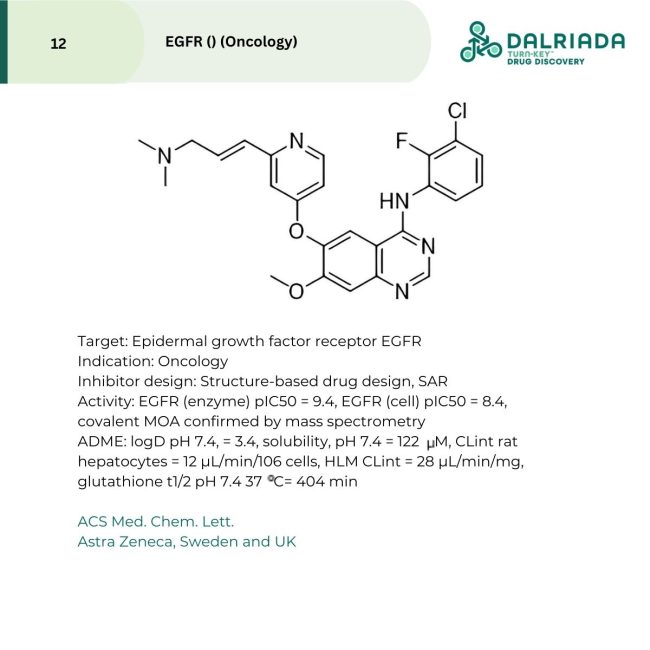
12: Researchers at Astra Zeneca describe how a study to find new reactive groups beyond standard acrylamide-type warheads, led to the design and synthesis of vinylpyridines as covalent binding motifs incorporated in cysteine reactive covalent EGFR inhibitors. A quinazoline-containing vinylpyridine, 6 was identified as a starting point containing an unsubstituted 4-vinylpyridine warhead however the compound had a short half-life with glutathione demonstrating high reactivity with an increased risk of cysteine promiscuity and idiosyncratic toxicity. Further modifications focused on reducing the reactivity of the vinyl pyridine warhead which resulted in substituted vinyl compound 12, which showed high EGFR potency and good kinase selectivity. The results show that vinyl pyridines can be employed as alternative cysteine reactive warheads with tunable reactivity. Vinylpyridine 12 was applied as a covalent warhead to target cysteine 797 in EGFR. Initial leads were obtained through structure-based design, with compound 6 showing high EGFR potency in biochemical and cellular assays. The design was focused on reducing reactivity by further substitution of the vinyl motif. Compound 12 contains a N, N- dimethylamino-methane substituent on the vinyl motif and combined high potency, improved physicochemical properties, and lower reactivity (e.g. glutathione). Both compounds 6 and 12 showed good kinase selectivity, mainly targeting EGFR and EGFR mutants in a panel of 127 kinases. The authors note that the scope may be extended with additional 5- and 6-membered heteroarenes. The tunable nature of vinylpyridines will be a welcome addition to the drug designer’s repertoire for selectively targeting cysteines covalently.
5
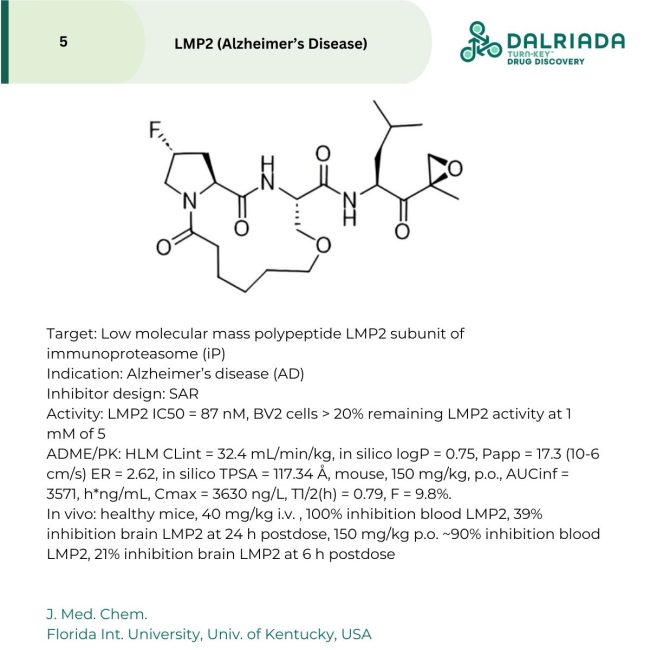
5: The study by Park et al demonstrated that linear peptide epoxyketones targeting the immunoproteasome (iP) specifically LMP2 can improve cognitive function in mouse models of Alzheimer’s disease (AD) independently of amyloid deposition. The researchers prepared a series of four novel macrocyclic peptide epoxyketones and compared them with existing macrocyclic iP inhibitors. Compound 5 was selected as an AD drug lead, and when administered intravenously or orally into healthy BALB/c mice, considerable iP (LMP2) inhibition was observed, indicating blood-brain barrier permeability and target engagement. The brain is the most sophisticated and vital organ in the body, and the most challenging endeavor in designing CNS drugs is to overcome the BBB. Although several linear peptide-based constitutive proteasome (cP) inhibitors are in the clinic or under clinical development, they are only slightly brain permeable or impermeable. The macrocyclic backbone improved metabolic stability and BBB permeability (although in silico TPSA at ~117 is considered high for free brain exposure from most reports). When administered orally to healthy mice at the high dose of 150 mg/kg, compound 5 had a modest but encouraging oral bioavailability of about 10%. Lower doses administered i.v., 40- 100mg/kg were also efficacious in inhibiting LMP2 in blood and brain. While compound 5 will likely require additional optimization for oral delivery due to first pass metabolism and/or formulation optimization, the study supports the potential of compound 5 as an AD drug lead capable of oral administration. Orally administrable drugs are advantageous in providing both convenience and dosing flexibility for AD patients. Additional studies regarding the in vivo efficacy and mechanism of compound 5 are ongoing in two distinct AD mouse models and results are keenly awaited.
Reference: https://doi.org/10.1021/acs.jmedchem.3c02488
Sovleplenib (41)
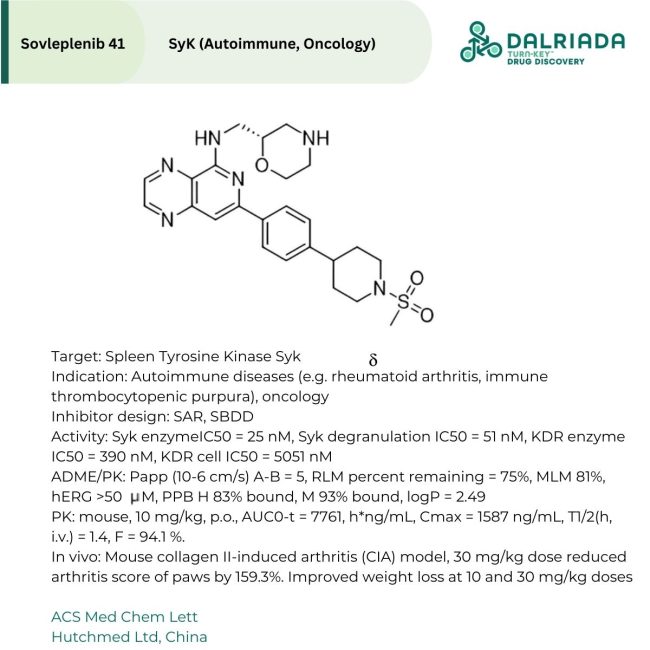
Sovleplenib (41): The authors describe the discovery of the clinical-stage Syk inhibitor sovleplenib (41) following an SAR investigation and PK optimization of a pyrido[3,4-b]pyrazine scaffold. Sovleplenib is a potent, selective Syk inhibitor with favorable preclinical PK profiles and robust anti-inflammation efficacy in a preclinical collagen II-induced arthritis model (CIA). It is now being developed for treating autoimmune diseases such as immune thrombocytopenic purpura (ITP) and warm antibody hemolytic anemia (wAIHA), as well as hematological malignancies. In the CIA model, compound 41 significantly reduced the arthritis score of the paws with inhibition rates of −8.3%, 7.7%, 96.5%, and 159.3% at 1, 3, 10, and 30 mg/kg QD, respectively. It reversed the disease’s progress to its normal status at a dose of 30 mg/kg QD. Compound 41 also significantly improved weight loss compared to the vehicle control group and R406 (active metabolite of comparator fostamatinib) group at doses of 10 and 30 mg/kg QD. Compound 41 exhibited a larger safety window than R406 in terms of kinase insert domain receptor (KDR), one of the major causes of hypertension for fostamatinib in clinical trials. Compound 41 has also shown superior kinome selectivity and inhibition of Ret kinase activity compared to fostamatinib. Compound 41 has a favorable preclinical pharmacokinetic profile, good selectivity and demonstrated potent efficacy in the mouse disease model. In a phase III placebo-controlled, double-blind randomized trial, 41 met the primary end point of durable response rate in adult patients with ITP. The compound is also being developed in a phase II study for wAIHA and phase I/II clinical trials for hematologic malignancies.
49
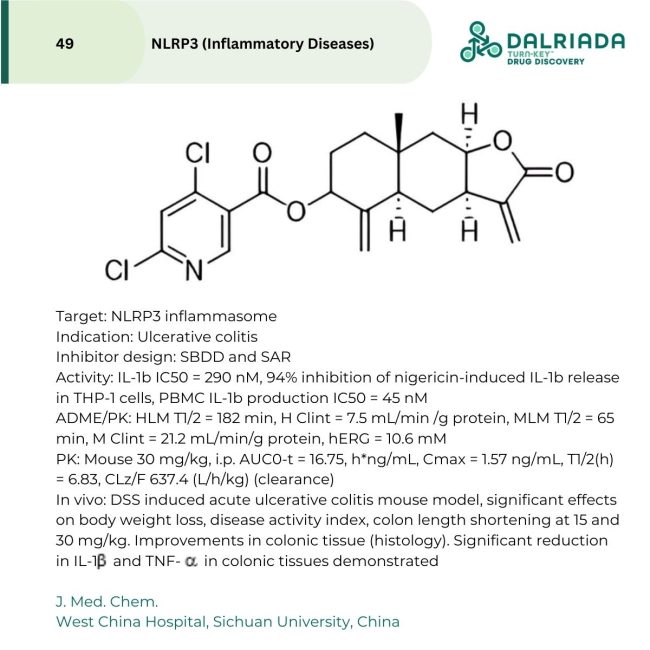
49: The research team at Sichuan University were interested in identifying a novel NLRP3 inflammasome inhibitor. The NLRP3 inflammasome is a viable therapeutic target due to its abnormal activation in a variety of chronic inflammation-related disorders and structurally diverse inhibitors of the NLRP3 inflammasome have gained significant attention in recent years. Pharmaceutical and biotech companies have invested heavily in developing drugs targeting this pathway and while several promising inhibitors have entered clinical trials, no drugs have been approved for market use, necessitating the need to identify new anti-NLRP3 inflammasome agents. The natural product, eudesmane-type sesquiterpene lactone (IAL) was identified by the authors as an active scaffold and 64 derivatives of IAL were prepared. Compound 49, based on this scaffold, was the most promising anti-NLRP3 drug, exhibiting increased activity, metabolic stability, and decreased toxicity compared to parent IAL. Compound 49 effectively inhibited nigericin-induced IL-1β production in THP-1 cells and improved DSS-induced ulcerative colitis in a DDS-induced ulcerative colitis in vivo model. The mechanism of compound 49 involves covalent binding to Cys 279 in the NACHT domain of NLRP3, blocking the assembly and activation of the NLRP3 inflammasome. SAR for the new IAL based series and comparison to compounds which share a structurally similar α,β-unsaturated lactone moiety binding to the NACHT domain support binding through the Michael acceptor. The authors report that further studies will focus on optimizing colon exposure and currently suggest compound 49 can be used as a tool compound to assess therapeutic potential for NLRP3-related diseases.
Reference: https://doi.org/10.1021/acs.jmedchem.4c00357