In this issue of “Small Molecule Highlights” 4 new small molecules are summarized from recent drug discovery journals. These molecules target G9a/GLP, SLC13A5, PI3Kδ and PRMT5.
MS8709
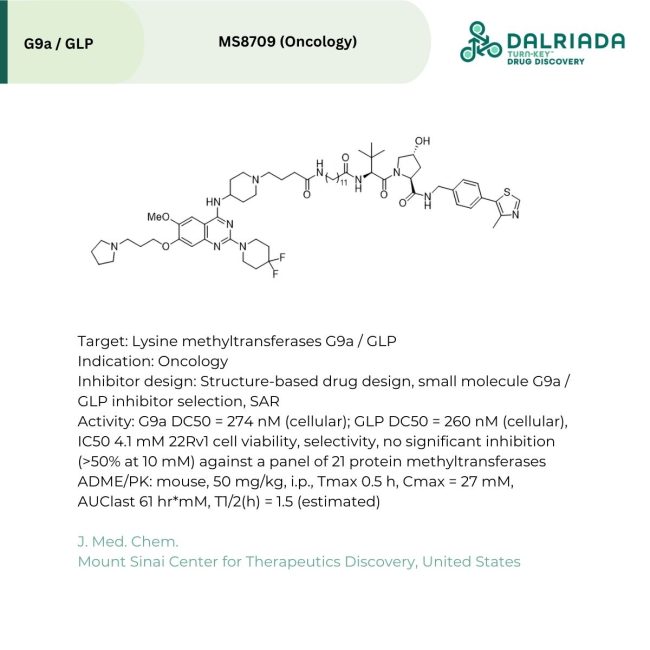
MS8709: The Sinai Center for Therapeutic Discovery team report on the first-in-class identification of a proteolysis targeting chimera (PROTAC) to inhibit G9a/GLP in cancer studies. G9a and G9a-like protein (GLP) are lysine methyltransferases that catalyze the mono- and dimethylation of histone H3 lysine 9 (H3K9), transcriptionally repressive chromatin marks, and nonhistone proteins. They play important roles including cell development, differentiation, and hypoxia response. Overexpression of G9a has been reported in various cancer types, including breast, lung, leukemia, bladder, colorectal, and prostate. G9a/GLP has noncanonical oncogenic functions, such as methylating nonhistone proteins and acts as a coactivator independent of its catalytic domain. Several G9a/GLP enzymatic inhibitors were previously reported by the Sinai Center, but none have progressed to the clinic due to limited anticancer activity. A more effective therapeutic strategy is required to target G9a/GLP-dependent cancers by targeting G9a/GL catalytic inhibition and noncatalytic oncogenic functions. A PROTAC approach to address the limitations of earlier studies is detailed. MS8709 has emerged from the studies as a first-in-class G9a/GLP PROTAC degrader. MS8709, based on G9a/GLP inhibitor UNC0642, recruits the E3 ligase VHL and induces G9a and GLP degradation in prostate cancer cells (22Rv1), (K562) myelogenous leukemia and H1299 NSCLC cell lines, not found with catalytic inhibitor UNC0642 alone. MS8709 has acceptable mouse PK to warrant in vivo efficacy studies. Going forward, it will be interesting to see if this PROTAC approach overcomes the catalytic inhibitor hurdles found previously. Hopefully chimeric compounds will enter the clinic soon.
Reference: https://doi.org/10.1021/acs.jmedchem.3c02394
LBA-3
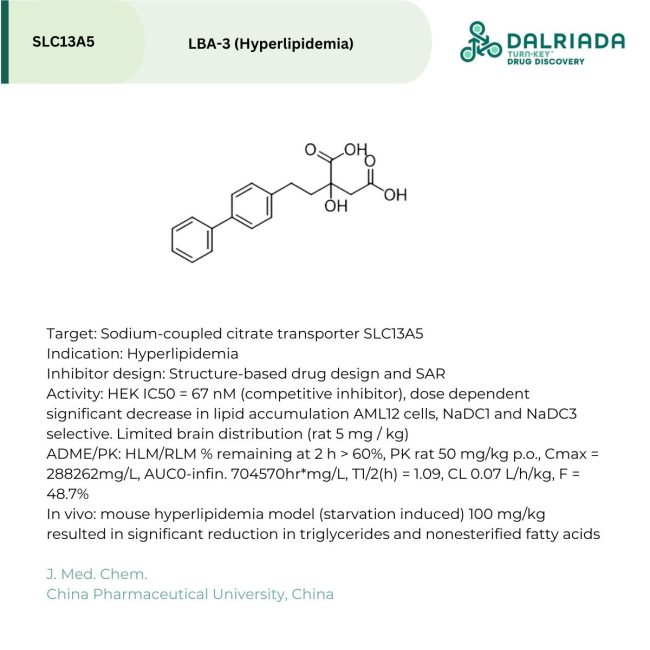
LBA-3: Zhang and co-workers present results on the inhibition of SLC13A5, a target for metabolic diseases with the focus on treating hyperlipidemia. SLC13A5 inhibitors are interesting as a potential alternative treatment for patient’s intolerant to statins. Pfizer has previously reported inhibitors of SLC13A5 including PF-06649298, however limited in vivo exposure and potency have hindered progress with this molecule. Using binding models with published ligands an unoccupied hydrophobic cleft was identified and the authors sought to design molecules that maximize the occupancy of the transporter cavity. As a result, several novel SLC13A5 inhibitors were identified by the China Pharmaceutical University team, one of which, LBA-3, has demonstrated encouraging results in in vitro and in vivo studies. With an IC50 value of 67 nM, LBA-3 exhibits an 8-fold enhancement in SLC13A5 inhibition compared to PF-06649298 and was selective against NaDC1 and NaDC3 isoforms. Furthermore, it demonstrates bifunctionality by acting as both a substrate and a competitive inhibitor of SLC13A5 without compromising the expression of the transporter. Hepatic lipid production is reduced due to LBA-3’s suppression of key hepatic enzymes, ACLY, ACC1, FASN, and HMGCR involved in lipid synthesis. LBA-3 dramatically raises plasma citrate levels and reduces hepatic lipid accumulation in vivo. LBA-3 was found to have low brain concentrations (PO administration, 5 mg/kg SD rats) in a tissue distribution study. Mutations or deficiencies in brain SLC13A5 are linked with early onset epilepsy in children therefore low brain penetration is required to reduce the risk, however following a high dose (300 mg/kg) in vivo mouse study, some seizure symptoms were observed. To reduce the danger of cerebral side effects, more research will be required to understand how LBA-3 and brain SLC13A5 interact. Nevertheless, the capacity of LBA-3 to return hepatic lipid levels to normal highlights the compound as a promising lead for treating hyperlipidemia supporting further evaluation in the management of metabolic disorders.
Reference: https://doi.org/10.1021/acs.jmedchem.4c00260
(S)-36
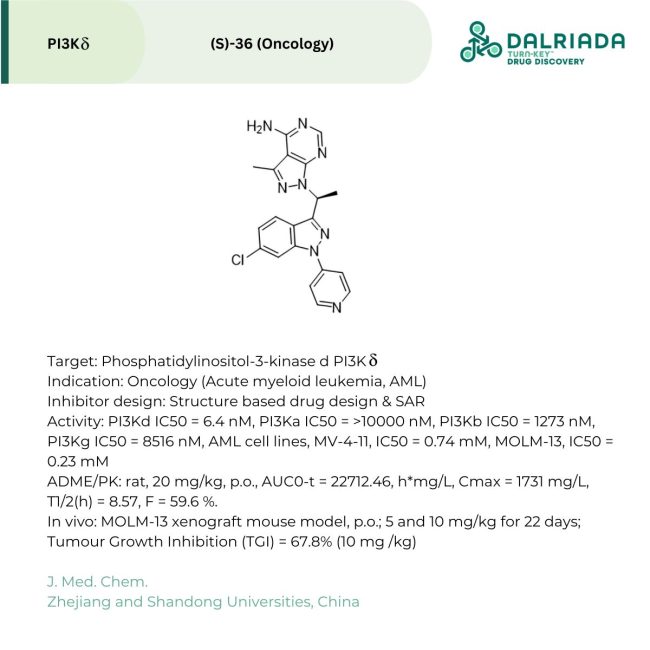
(S)-36: The researchers at Zhejiang and Shandong University have continued studies to identify improved PI3Kδ inhibitors for the treatment of acute myeloid leukemia (AML). The current article reports on the development of a new class of powerful and selective PI3Kδ inhibitors, optimized from the group’s historic compound sets. Forty-four compounds were designed and prepared, from which compound (S)-36 was identified having strong inhibitory activity, high selectivity, and antiproliferative properties against two AML cell lines, MV-4-11 and MOLM-13. The oral bioavailability of (S)-36 was high (rat, F = 59.6%). (S)-36 showed no overt toxicity, no mortality or weight loss at an oral dosage of 10 mg/kg in the mouse MOLM-13 subcutaneous xenograft model, suppressing tumor progression with a tumor growth index (TGI) of 67.8%. Moreover, it strongly inhibited the PI3K/AKT pathway in AML models, reducing cell division and triggering apoptosis both intratumorally and cellularly. The compound binding mode, biological activity, and physiochemical properties were rationalized by molecular modeling and flexibility analysis. Docking analysis revealed the 4-aminopyrazolo[3,4-d] pyrimidine moiety formed two key hydrogen bonds to the ATP-binding site of the PI3Kδ kinase domain between ligand and GLU826 and VAL828 in the hinge region. The flexibility index which reflects the rigidity of a molecule was also lowered compared with an early analogue, consistent with a reduction in the number of rotatable bonds and conformers. In summary, (S)-36 shows promise as a potential treatment for AML.
Reference: https://doi.org/10.1021/acs.jmedchem.4c00094
TNG908
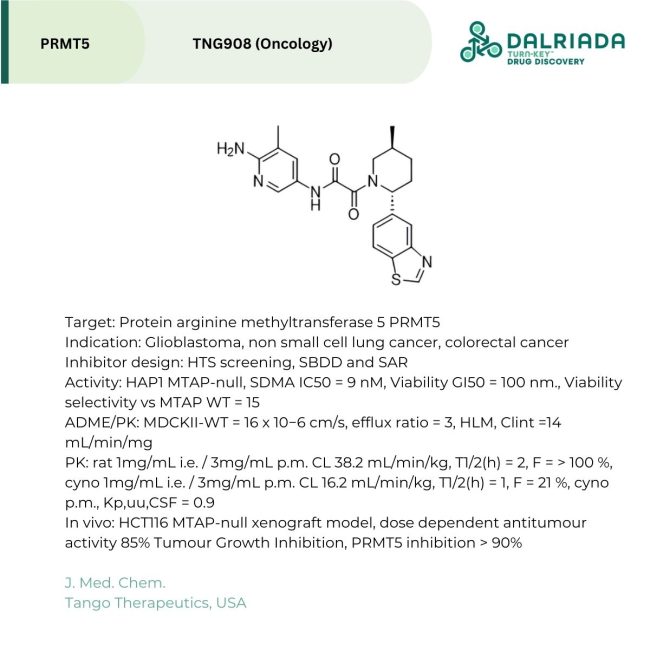
TNG908: Researchers at Tango Therapeutics describe the design and hit finding approach leading to selective type II protein arginine methyltransferase (PRMT5) inhibitors. The team set out to design a compound that can utilize the accumulation of methylthioadenosine (MTA, a partial PRMT5 inhibitor) by binding to PRMT5 in an MTA cooperative, substrate-competitive manner, thereby achieving selective PRMT5 inhibition, killing methylthioadenosine phosphorylase (MTAP)-null tumor cells while sparing MTAP-containing normal cells. An initial oxamide containing hit was identified with a promising property profile that was progressed using structure-based drug design and SAR to afford lead TNG908. The authors demonstrated that PRMT5 inhibitor TNG908 can specifically destroy MTAP-null tumor cells, having a homozygous deletion of the MTAP gene, while MTAP normal cells are left unaffected. When TNG908 attaches to the PRMT5-MTA complex, MTAP-null cells are killed with a 15-fold higher degree of selectivity than MTAP WT cells. TNG908 properties, including desirable permeability and low efflux ratio, enable TNG908 to cross the blood-brain barrier. The lead demonstrated selective antitumor activity in mouse xenograft models, facilitating clinical research for the treatment of both CNS and non-CNS cancers with the MTAP deficiency. TNG908 has low to moderate clearance, moderate to high bioavailability across species. It was effective in xenograft models and shows specific in vivo activity in a model of colorectal cancer. TNG908 was nominated as a development candidate and is currently in a Phase I/II clinical study (NCT05275478).
Reference: https://doi.org/10.1021/acs.jmedchem.4c00133